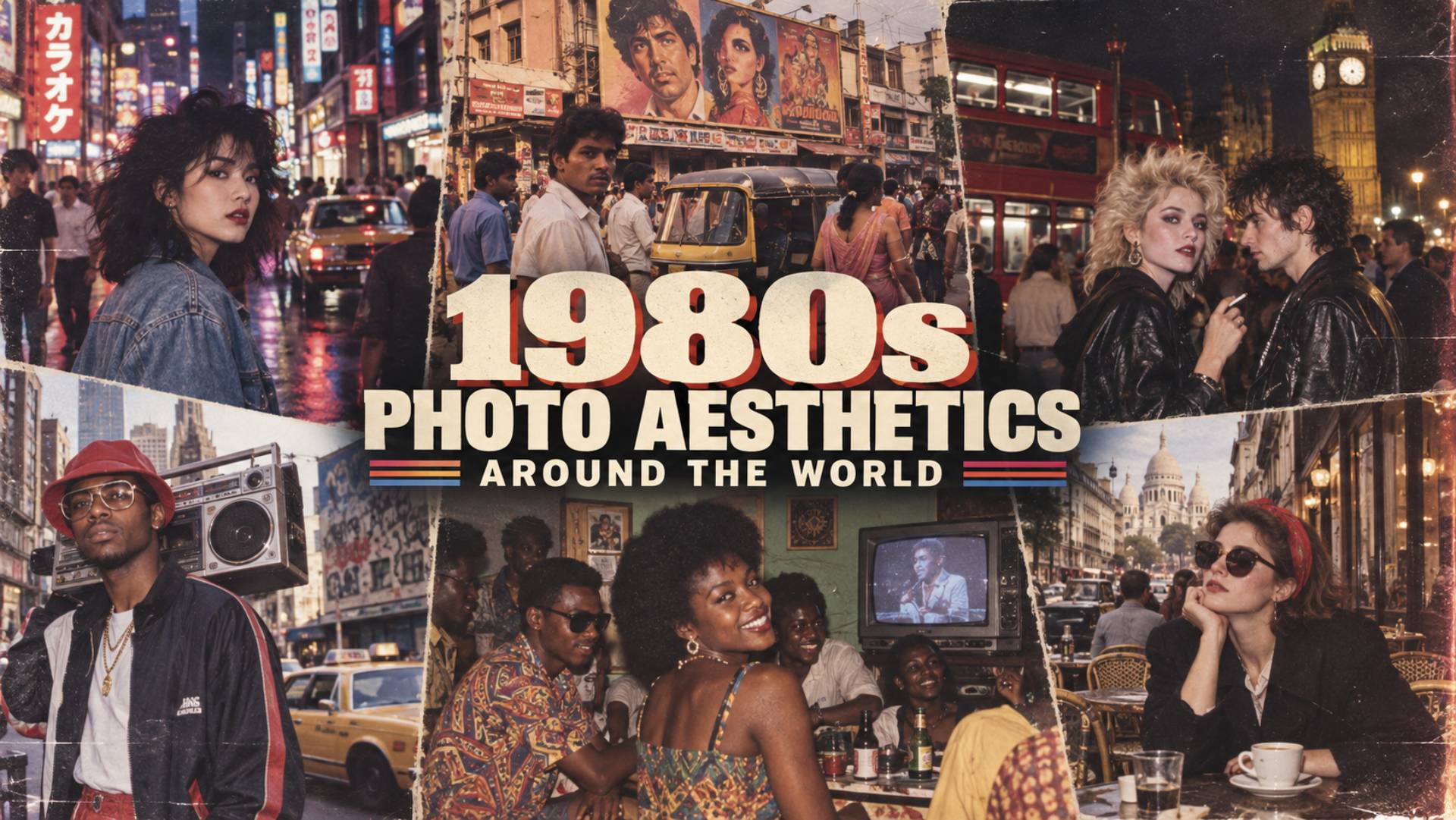
combining period-accurate clothing, Most coverage of the 1980s AI photo trend assumes the decade looked more or less the same everywhere — big hair, shoulder pads, neon, done. It didn’t. A photograph taken in 1985 looked entirely different depending on whether you were standing on a Manhattan street corner, in a Tokyo record shop, on a Rio beach, or in a Milan design studio. The clothes, the light, the architecture, even the mood of the photograph itself, were shaped by the culture around them.
This piece takes the trend somewhere most guides don’t: 12 cities and cultures, and 20 prompts built around what actually made each one visually distinct in the 1980s, rather than one generic “retro” template stretched over every location.
╔════════════════════════════════════════════════════════════════╗
📸 Key Takeaways
√ Global variation: 1980s photography looked different across countries, cities and cultural scenes.
√ Authentic details: Lighting, fashion, architecture, film colour and local design elements make retro AI images more believable.
√ 20 global prompts: Each prompt recreates a distinct international interpretation of the 1980s rather than a generic retro look.
√ Better prompts: Include location, clothing, camera style, lighting, props and period-appropriate surroundings.
√ Analogue feel: Film grain, flash glare, faded colours and soft focus help AI images resemble genuine 1980s photographs.
╚═════════════════════════════════════════════════════════════════════════════╝
Why These 12 Places
We picked cities and cultures with a genuinely recognisable 1980s visual identity — not just “somewhere in the 80s,” but a specific look tied to a real scene: New York’s street fashion, Tokyo’s city-pop aesthetic, Berlin’s underground club culture, Mumbai’s film industry. Each one gives an AI tool something concrete and specific to work with, which is exactly what produces a convincing result rather than a generic pastiche. The list spans five continents deliberately, so this isn’t a Western-only take on a genuinely global decade.
A quick note on approach: these prompts aim to capture each culture’s real, well-documented 1980s aesthetic — the fashion, design and photographic style people actually associate with that place and era — rather than leaning on lazy stereotypes. If you’re recreating a scene from a culture that isn’t your own, it’s worth doing a little of your own reading on the period first, so the details you add feel considered rather than costume-like
Region |
Years |
1980s Aesthetic |
Key Visual Style |
|---|---|---|---|
| √ North America | 1984–1987 | Hip-hop street culture, Wall Street power dressing, glam-rock nightlife and beach aerobics | Gritty 35mm photography, neon nightlife, bold fashion, strong daylight and polished magazine-style portraits |
| √ Latin America | 1985–1986 | Colourful beach culture and traditional family studio photography | Warm saturated colours, tropical sunlight, soft studio lighting and vintage family-album tones |
| √ Europe | 1983–1988 | Haute couture, café culture, Italian design, runway fashion and Berlin post-punk style | High-contrast editorial photography, geometric design, muted lifestyle colours, dramatic lighting and grainy reportage |
| √ Asia | 1984–1987 | City-pop, neon street culture, Indian cinema glamour, hand-painted film posters and youth fashion | Neon reflections, rich warm colours, glossy styling, cinematic lighting, saturated poster art and 35mm film grain |
| √ Oceania | 1985–1988 | Australian surf culture and relaxed harbourside lifestyle | Bright natural sunlight, sun-faded colours, golden-hour lighting, beach snapshots and soft holiday-film tones |
Before You Start
The same fundamentals from the wider trend apply here, doubled: be specific about the year and setting, name one coherent outfit rather than five clashing ones, and explicitly tell the AI tool to preserve your facial structure so it doesn’t quietly redesign your face along with the wardrobe. Cultural specificity works the same way as any other detail in a prompt — the more precisely you name it, the less the AI has to guess, and the less likely it is to default to a generic, flattened version of the look.
⇒ North America
1. New York street style, 1984
Recreate me on a New York City street corner in 1984, in the visual style of the era’s hip-hop and electro street culture. Dress me in a bold tracksuit or bomber jacket, gold-tone chain accessory, and fresh sneakers, with a boombox nearby. Use the gritty, high-contrast look of 35mm street photography, natural daylight, and a backdrop of period storefronts, graffiti-tagged walls and yellow cabs. Preserve my exact facial features and proportions.
2. New York Wall Street portrait, 1987
Create a confident corporate portrait as though photographed near Wall Street in 1987. Preserve my face and natural build. Dress me in a broad-shouldered power suit with a bold tie or blouse and statement accessories, holding a large mobile phone or briefcase. Use a Manhattan skyline backdrop, crisp daylight, and the polished, ambitious visual tone of a period business magazine cover.
3. Los Angeles Sunset Strip nightlife, 1986
Recreate me outside a Sunset Strip rock club in Los Angeles in 1986. Preserve my facial identity. Add teased, voluminous hair, a leather jacket or bandana, and denim, with neon club signage and a queue of similarly dressed people in the background. Use warm streetlight, a hazy evening atmosphere, and 35mm film grain to capture the glam-rock energy of the period.
4. Los Angeles beachside aerobics class, 1985
Turn my full-body photo into a bright, energetic beachside aerobics scene in Los Angeles in 1985. Preserve my face and natural proportions. Add a coordinated leotard, leggings and headband in bold primary colours, with palm trees and a boardwalk in the background. Use strong California sunlight, natural movement, and realistic 35mm photography rather than an exaggerated cartoon style.
⇒ Latin America
1.Rio de Janeiro beach portrait, 1986
Recreate me on Copacabana or Ipanema beach in Rio de Janeiro in 1986. Preserve my exact facial features. Dress me in vividly coloured period beachwear, with the mosaic promenade, striped beach umbrellas and Sugarloaf Mountain visible in the distance. Use bright natural sunlight, warm skin tones, and the lively, colour-saturated feel of a period holiday photograph.
2. Mexico City family studio portrait, 1985
Recreate my family group as though posing at a photography studio in Mexico City in 1985. Preserve every face, age and relationship accurately. Use warm, formal period clothing, a painted studio backdrop, and soft frontal lighting, with the rich, warm colour tone typical of a well-kept Mexican family album from the era. Include one subtle period detail, such as a framed photo or simple jewellery, and avoid modern objects.
⇒ Europe
1. Paris haute couture editorial, 1983
Create an elegant fashion-editorial-style portrait of me as though photographed for a Paris fashion magazine in 1983. Preserve my facial identity and natural skin texture. Style me in a structured, statement-shouldered couture silhouette with bold accessories, photographed against a minimalist studio backdrop. Use dramatic single-source lighting and the refined, high-contrast look of period fashion photography.
2. Paris café portrait, 1986
Recreate me seated at a small pavement café table in Paris in 1986. Preserve my face and proportions. Dress me in a chic, tailored period outfit, with a patterned scarf and sunglasses resting on the table. Use soft overcast daylight, wrought-iron café furniture, and the muted, elegant colour palette of a period French lifestyle photograph.
3. Milan design studio portrait, 1984
Recreate me inside a Milan design studio in 1984, surrounded by bold, geometric furniture and colour-blocked shapes in the style of the era’s influential Italian design movement. Preserve my facial features accurately. Dress me in sharply tailored, architectural clothing that complements rather than clashes with the furniture. Use clean studio lighting and a confident, editorial composition.
4. Milan runway-adjacent portrait, 1988
Create a portrait of me backstage at a Milan fashion show in 1988. Preserve my identity closely. Style me in a bold-shouldered, richly coloured outfit with dramatic period hair and makeup, standing among garment racks and mirrors. Use warm backstage lighting and the slightly candid, unposed energy of a fashion photographer’s behind-the-scenes shot.
5.Berlin underground club portrait, 1985
Recreate me inside a West Berlin underground club in 1985, in the visual style of the city’s post-punk and industrial music scene. Preserve my face and natural proportions. Dress me in monochrome, asymmetric clothing with striking period makeup and hair. Use stark, high-contrast lighting, exposed brick or concrete surroundings, and grainy black-and-white or desaturated colour film.
6. Berlin street portrait near the Wall, 1987
Create a documentary-style street portrait of me in West Berlin in 1987. Preserve my facial identity accurately. Dress me in practical, slightly rebellious period streetwear — a worn leather jacket, band T-shirt with no real logo, and boots. Use overcast natural light, graffiti-covered concrete in the background, and the muted, journalistic colour tone of period reportage photography.
⇒ Asia
1. Tokyo city-pop portrait, 1984
Recreate me in the visual style of Japan’s city-pop era in Tokyo, 1984. Preserve my exact facial features. Dress me in a soft pastel outfit with clean, glossy styling, photographed against a stylised skyline or a vintage car with chrome detailing. Use warm sunset lighting, a slightly airbrushed but photographic finish, and the polished, optimistic mood of period Japanese album artwork.
2. Tokyo arcade and neon street scene, 1987
Place me on a neon-lit Tokyo street in 1987, near glowing arcade signage and vending machines. Preserve my face and natural build. Dress me in bold, colour-blocked period streetwear. Use vivid neon lighting balanced against realistic skin tones, light rain-slicked pavement reflections, and 35mm film grain, avoiding an overly futuristic or cyberpunk look.
3. Mumbai film studio glamour portrait, 1985
Recreate me as a Hindi cinema actor photographed in a Mumbai film studio in 1985. Preserve my face and expression closely. Style me with voluminous period hair, expressive makeup and a glamorous period outfit, photographed against a painted studio backdrop with dramatic key lighting. Use the rich, warm colour tone typical of period Indian film photography, and avoid referencing any specific real actor or existing film.
4. Mumbai street cinema poster style, 1987
Turn my portrait into the central figure of an original hand-painted-style Indian film poster from 1987. Preserve my facial likeness. Give me an intense expression and bold period styling, surrounded by smaller illustrated scenes suggesting a dramatic story. Use the saturated colours and painterly texture of period Bollywood poster art, without copying any real film title, actor or existing poster design.
5. Hong Kong neon street portrait, 1986
Recreate me on a crowded, neon-lit Hong Kong street in 1986, with dense vertical signage in the background. Preserve my exact facial features. Dress me in sharp period streetwear with a light jacket suited to a humid evening. Use rich neon colour reflected on wet pavement, layered signage (kept abstract or unreadable rather than fabricated text), and the moody, cinematic tone associated with period Hong Kong film photography.
6. Seoul youth street style portrait, 1986
Create a portrait of me as a fashionable young person on a Seoul shopping street in 1986. Preserve my facial identity and natural proportions. Dress me in bold-shouldered, colour-coordinated period streetwear with a stylish period hairstyle. Use natural daylight, busy shopfronts with abstract (non-legible) signage, and the crisp, optimistic tone of a period Korean lifestyle photograph.
⇒ Oceania
1. Sydney surf culture portrait, 1985
Recreate me at a Sydney beach — think Bondi or Manly — in 1985, in the relaxed style of the era’s surf culture. Preserve my face and natural build. Dress me in period boardshorts or a swimsuit with a zinc-style nose stripe optional, standing beside a surfboard and a classic combi-style van. Use bright natural sunlight, sand and surf in the background, and the sun-bleached, slightly faded colour of a period beach snapshot.
2. Sydney harbourside portrait, 1988
Create a relaxed portrait of me by Sydney Harbour in 1988, with the bridge or period ferry visible in the background. Preserve my exact facial features. Dress me in smart-casual period clothing suited to a harbourside evening out. Use warm golden-hour light, natural water reflections, and the soft, slightly faded colour of a well-kept period holiday photograph.
Making a Global Prompt Feel Authentic, Not Costume-y
The difference between a convincing cultural scene and a caricature usually comes down to restraint. Pick one or two real, well-documented details from the place and era — a specific music scene, a real design movement, a recognisable local landmark — rather than piling on every visual cliché associated with that culture at once. It’s the same principle that applies to any 1980s AI prompt: specificity over exaggeration. If a result comes back leaning into a stereotype rather than a genuine period look, ask for a revision that keeps the setting but “removes exaggerated or stereotypical styling and replaces it with an accurate, understated period detail instead.”
Frequently Asked Questions
Do I need to actually be from these places to use these prompts?
No — these are creative, aesthetic prompts inspired by each city’s documented 1980s visual culture, not a claim about your own background. Treat them the way you’d treat photographing yourself in a historical costume from any era: as an homage to a look, not an impersonation of an identity.
Why include design movements like Milan’s alongside street fashion and nightlife?
Because the 1980s look of a place wasn’t only about clothing — design, music and film all shaped how photographs from that place and decade actually looked. Milan’s design studios are as visually “1980s Milan” as any street-fashion shot would be.
Can I combine two cities in one prompt — say, Tokyo styling with a New York setting?
You can, but it tends to work against you here specifically, because the whole point of these prompts is cultural specificity. Two locations’ visual signals competing in one frame usually reads as confused rather than interesting.
How do I avoid a result that feels like a stereotype rather than a real period look?
Keep the prompt anchored to one or two specific, real details (a documented music scene, a real design style, an actual landmark) rather than a long list of “iconic” symbols, and ask explicitly for an “authentic, understated” treatment rather than an exaggerated one if your first result overdoes it.
Which of these is easiest to get right on the first attempt?
Studio-based prompts — the Mexico City family portrait, the Mumbai film studio glamour shot, the Milan design studio portrait — tend to need fewer corrections than busy street scenes, simply because there’s less going on in the background for the AI to get wrong.
Final Thought
The visual language of the 1980s was never limited to one country, colour palette, or photographic style. From neon-lit city streets and bold fashion to family snapshots, music scenes, traditional clothing, and everyday urban life, each region brought its own cultural identity to the decade.
These 20 AI prompts offer a starting point for recreating 1980s photo aesthetics around the world while keeping each image rooted in a distinct place, mood, and cultural influence. The strongest results come from combining period-accurate clothing, architecture, lighting, film characteristics, hairstyles, props, and local details rather than relying on a generic “retro” look.
Experiment with different camera angles, film stocks, colour treatments, environments, and levels of analogue imperfection to make each generation feel more authentic. With thoughtful prompting, AI can help transform the global visual culture of the 1980s into compelling images that feel nostalgic, cinematic, and culturally distinctive.